What is cloud networking? A comprehensive overview


Cloud services power everything from everyday apps to critical business systems, and cloud networking enables those services to be reachable and manageable.
Because it’s often confused with broader “cloud” terms, this article breaks down what cloud networking is, the common forms it takes, and why organizations use it.
What is cloud networking?
Cloud networking refers to the technologies, infrastructure, and operational practices used to design, connect, and run networks within and between cloud environments. It often extends to on-premises data centers, edge networks, applications, and users.
Typically, organizations use cloud networking to build logically isolated networks in the cloud and connect workloads, users, and sites. In some cases, this connectivity resembles a wide area network (WAN) when it spans regions, offices, and cloud environments.
Generally, cloud networking focuses on the network layer (the design, topologies, technologies, and operational practices) that make it possible to connect to, use, and integrate various cloud-based endpoints.
Cloud network management may take place locally, in the cloud, or through dedicated third-party service providers. Many organizations can start with internet connectivity, but some also use private connectivity options (such as dedicated or partner interconnects), depending on reliability, performance, or compliance needs.
Cloud services vs. cloud networking
Cloud-based services are used regularly by many people and organizations. Consumer services, such as iCloud, Google Drive, WhatsApp, and Netflix, rely on cloud technology to deliver apps and data over the internet. For everyday use, most of the networking is handled behind the scenes, and access usually comes down to signing in and using the service.
In business environments, the challenge often isn’t using a cloud service; it’s cloud networking: connecting services and workloads to each other and to on-premises systems, while applying the right access controls, monitoring, and security.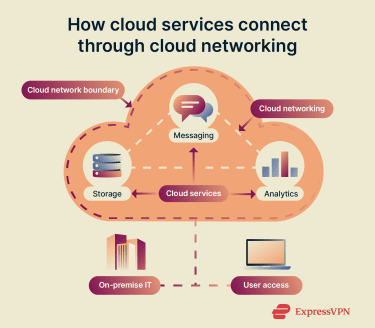
Traditional networking vs. cloud networking
In a traditional network, administrators set up a local area network (LAN) or a wireless LAN (WLAN) to connect devices within a site (or across multiple sites). The network typically consists of workstations, local servers, and Internet of Things (IoT) devices connected by physical cables, Wi-Fi routers, and network switches.
A traditional network may span a single location or multiple sites. However, network topology is still largely tied to physical sites, which are connected via private circuits such as leased lines/multiprotocol label switching (MPLS), site-to-site virtual private networks (VPNs), or software-defined WANs.
Expanding, changing, or upgrading the network involves acquiring and deploying the additional hardware (and sometimes licenses), which the organization or individual is then responsible for installing, monitoring, maintaining, and upgrading.
This hardware can take the form of additional endpoints, networking equipment, or storage resources. Organizations typically can’t change a network on demand because of the lead times involved to source and deploy components.
In cloud networking, organizations provision cloud-based resources from a cloud service provider (CSP) that virtualizes and manages infrastructure. Organizations then design network architectures that connect these cloud-based resources to each other, to users, and to on-premises IT.
Because the underlying infrastructure is provider-operated, organizations usually pay for access and capacity as needed. These cloud environments may connect through networking features (for example, peering, VPNs, or private connectivity) and can also integrate at the application layer via services and APIs used to provision and manage resources.
Types of cloud networking
Cloud networking models and infrastructure are inherently flexible. Organizations today typically use a combination of them to achieve their networking goals and facilitate different business operations. While cloud networks share many fundamentals, they differ in cost, complexity, scalability, resilience, and other factors.
Public cloud networking
This is a common cloud deployment model, in which large providers offer access to cloud-based resources and services, typically through subscriptions. Services can be accessed over the internet (via web consoles and APIs), and some organizations also use private connectivity options for cloud access.
Multiple customers use a cloud provider’s services simultaneously. They are typically used because they are usually highly scalable, flexible, fast to deploy, and cost-effective compared to on-premises infrastructure.
There are many types of public cloud solutions that typically address specific business challenges or functions:
- Software-as-a-Service (SaaS): Provider-hosted applications delivered over the internet. The provider manages the underlying platform and infrastructure.
- Infrastructure-as-a-Service (IaaS): On-demand compute, storage, and networking where the customer manages the OS and above.
- Platform-as-a-Service (PaaS): A cloud model where the provider delivers a managed platform (runtime, middleware, tools) for deploying applications, while the customer manages the apps and data.
- Network-as-a-Service (NaaS): Networking delivered as a subscription/service. For example, managed connectivity, routing, security, and network functions.
Private cloud networking
These are cloud networks dedicated to a single organization. As single-tenant environments, the underlying resources aren’t shared with other customers or users.
Organizations may host private cloud networks (on-premises) while using cloud principles, such as automation, virtualization, and self-service. Some providers also offer logically isolated virtual networks, such as virtual private clouds (VPCs) and virtual network (VNet), which provide network-level isolation even when the underlying infrastructure is shared.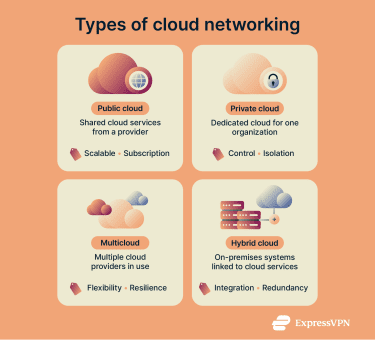
Multicloud networking
Many organizations use cloud services from multiple providers simultaneously. This is commonly called multicloud. Organizations can use this cloud networking type to combine specialized services, improve flexibility, and reduce dependence on a single vendor.
As multicloud environments grow more complex, organizations typically implement automation and orchestration to enforce consistent access and security controls.
Hybrid cloud networking
When organizations combine different cloud types, they create a hybrid cloud environment. It may involve a mix of private and public clouds that remain distinct but are connected to support data and application portability. It also often refers to models that connect on-premises networks to public cloud infrastructure.
For example, organizations may store and back up their data using on-premise storage and cloud storage platforms to improve redundancy if either environment is disrupted.
How does cloud networking work?
The breakdown below is simplified, but cloud networks of all kinds typically rely on the same components and concepts to connect systems and move data across on-premises and cloud-hosted servers.
Components of a cloud network
In cloud networking, physical resources, such as servers, are often logically subdivided through virtualization. In many environments, resources are allocated per customer/tenant as isolated virtual resources.
Virtual servers run in parallel on the same underlying resources to support different workloads, teams, or clients. Virtual resources can scale up or down quickly, sometimes automatically.
Similarly, cloud networks are divided into subnets to organize resources and simplify routing. Providers use virtual routing (e.g., an implicit router and route tables) to direct traffic within and between subnets. Access controls are typically enforced with firewall rules, security groups, and similar controls.
Cloud networks use gateways that enable communication with external networks, including on-premises environments. They often feature load balancers to distribute incoming traffic across backend targets and route only to healthy targets
Managing a cloud network
Unlike on-premises networks, CSPs operate and secure much of the underlying infrastructure. However, customers still manage the cloud networking configuration and controls they set up (which vary by service model).
Cloud providers also typically provide dashboards and tools for clients to monitor and manage network resources. Still, managing a complex hybrid or multicloud environment can become challenging. Some organizations use dedicated tools to manage integration and network configurations.
One example is software-defined networking (SDN), which logically abstracts the network management plane. This allows network administrators to manage traffic behavior and policies using dedicated software rather than configuring individual network devices.
Another important aspect of managing a cloud network is monitoring network activity to analyze performance and support security.
Connectivity in a cloud network
Cloud networks typically handle different forms of connectivity. The three main include cloud-to-cloud, cloud-to-on-premise, and user access.
IP addressing is supported by cloud provider tooling, but organizations may still need to plan and manage address space in complex hybrid or multicloud networks.
Cloud-to-cloud refers to connectivity between cloud environments or services on the same or different networks (for example, via routing/peering/private connectivity). APIs and integrations are also common, but those are application-layer connections rather than network paths.
Organizations must also establish direct, secure connections between on-premise IT and cloud services. Similarly, employees and end customers need reliable access to cloud services for day-to-day business functions. This often involves identity and permission controls to support secure access
How to secure a cloud network
In cloud networks, the main security challenge is to enforce consistent access controls and maintain visibility across distributed assets. Effective security also depends on reducing misconfigurations and consistently applying controls.
Common cloud networking security controls and practices
Firewalls are among the first lines of defense in nearly any network. They let organizations control which traffic can enter or leave specific networks and resources based on ports, protocols, and other rules.
Many organizations also adopt the secure access service edge (SASE) framework, which converges networking and security capabilities delivered as a service, often including software-defined wide area networking (SD-WAN) alongside security functions such as secure web gateways and zero-trust network access.
Cloud platforms typically provide built-in defenses to help protect against common cloud security threats and help manage identity and access controls. Some also offer tools that let organizations define and enforce their own security policies and network boundaries, such as segmentation, firewall rules, and private access to services, based on resources, users, and IoT security requirements.
Secure-by-design approaches emphasize secure defaults and reducing exposure from the start. Infrastructure-as-code can help enforce consistent configurations, reduce misconfigurations, and support logging and monitoring for visibility
Many cloud providers offer compliance programs and controls that can support regulatory requirements such as the General Data Protection Regulation (GDPR), the California Consumer Privacy Act (CCPA), or the Health Insurance Portability and Accountability Act (HIPAA), but they don’t remove an organization’s responsibility to implement compliant configurations and processes.
Can VPNs make cloud networking more secure?
In enterprise settings, remote-access VPNs often reduce exposure by keeping internal cloud services off the public internet. Rather than allowing direct access, organizations may require employees to connect through a trusted VPN gateway, restricting internal tools to accept requests only from the private network. This creates an encrypted tunnel to the corporate network, helping protect data in transit and centralizing access through a controlled entry point.
However, VPNs are only one layer of security and are typically combined with identity-based access controls, multi-factor authentication (MFA), and network segmentation.
Benefits of cloud networking
When leveraged intelligently, cloud networking offers organizations a variety of competitive advantages.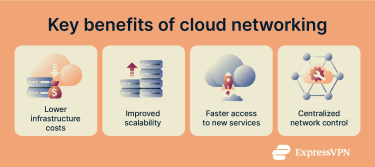
Cost efficiency
Utilizing networking architecture and technologies managed by CSPs can reduce upfront costs compared to fully in-house deployments. Organizations often pay based on subscription tiers or usage-based pricing models.
This can reduce the cost and effort of procuring, installing, and managing additional physical hardware, such as on-premises servers or data center equipment.
Scalability
Cloud providers build capacity to support growing demand and can provision resources on demand, often within minutes.
This enables organizations to quickly commission or decommission resources and cloud services as needed. The result can be improved performance and stability, helping minimize disruptions and support better customer experiences.
Cloud services are also well-suited to handling traffic spikes by scaling resources up or down as demand changes.
Flexibility
There are many SaaS, PaaS, and IaaS services available, offering a wide range of functions and specialized capabilities.
If a business is missing specific tools or capabilities in its IT stack, it can adopt a cloud service that provides them. This allows rapid adaptation to new trends, customer needs, and challenges. Cloud services often provide APIs and integration tooling to connect systems and automate workflows.
Network management
Service providers often shoulder a significant portion of the operational burden for the underlying infrastructure, while customers manage the configurations and controls they set.
Cloud environments can also make network upgrades, expansions, or contractions easier to execute because capacity can be adjusted without deploying new hardware.
Many cloud platforms provide built-in support for continuous integration/continuous deployment (CI/CD) tooling, container orchestration, and automated scaling. This allows applications to be built, deployed, and adjusted to demand with less manual configuration.
With cloud networking, administrators can often manage cloud assets via easy-to-use dashboards and management tools offered by cloud services.
FAQs: Common questions about cloud networking
What are the key components of cloud networking?
Cloud networking is a complex endeavor that involves a mix of underlying infrastructure and logical network services. Though far from exhaustive, key components include virtualization, subnets, gateways, load balancing, and IP addressing.
What is the difference between cloud computing and cloud networking?
Cloud computing refers to the delivery of computing resources and services over the cloud (such as compute, storage, and applications). Cloud networking encompasses the connectivity to and between those cloud computing resources, as well as security controls, user access, and management.
What skills are needed for cloud networking?
To effectively manage a cloud network, organizations typically need expertise in network architecture and design, cloud security, and (when applicable) data management. Where applicable, knowledge of specific regulations and cloud tools/services is also valuable. Practical experience with IP addressing, virtualization, subnetting, traffic optimization, and firewall configuration is also important.
How can cloud networking enhance business operations?
Cloud networking supports business growth by enhancing flexibility, agility, and scalability. It also allows organizations to optimize IT resources and reduce costs by lowering the need to deploy and maintain custom on-premises infrastructure for every workload. Cloud service providers (CSPs) absorb much of the overhead for the underlying infrastructure and some managed services, while organizations remain responsible for securely configuring and operating what they deploy in the cloud.
What are common security concerns in cloud networking?
Data breaches, misconfigurations, and human errors are among the most common cloud security risks. The larger the cloud network, the wider and more complex its attack surface can become, which can make it harder to consistently enforce security controls and permissions across assets.
How do companies choose a cloud networking provider?
Provider selection usually comes down to fit: required services, security controls, operational needs, and compliance obligations. In sectors with stricter security and data-handling requirements (for example, finance or healthcare), evaluation often focuses more heavily on governance, audit support, and the provider’s security and compliance offerings.
Take the first step to protect yourself online. Try ExpressVPN risk-free.
Get ExpressVPN