The history of ExpressVPN’s encryption



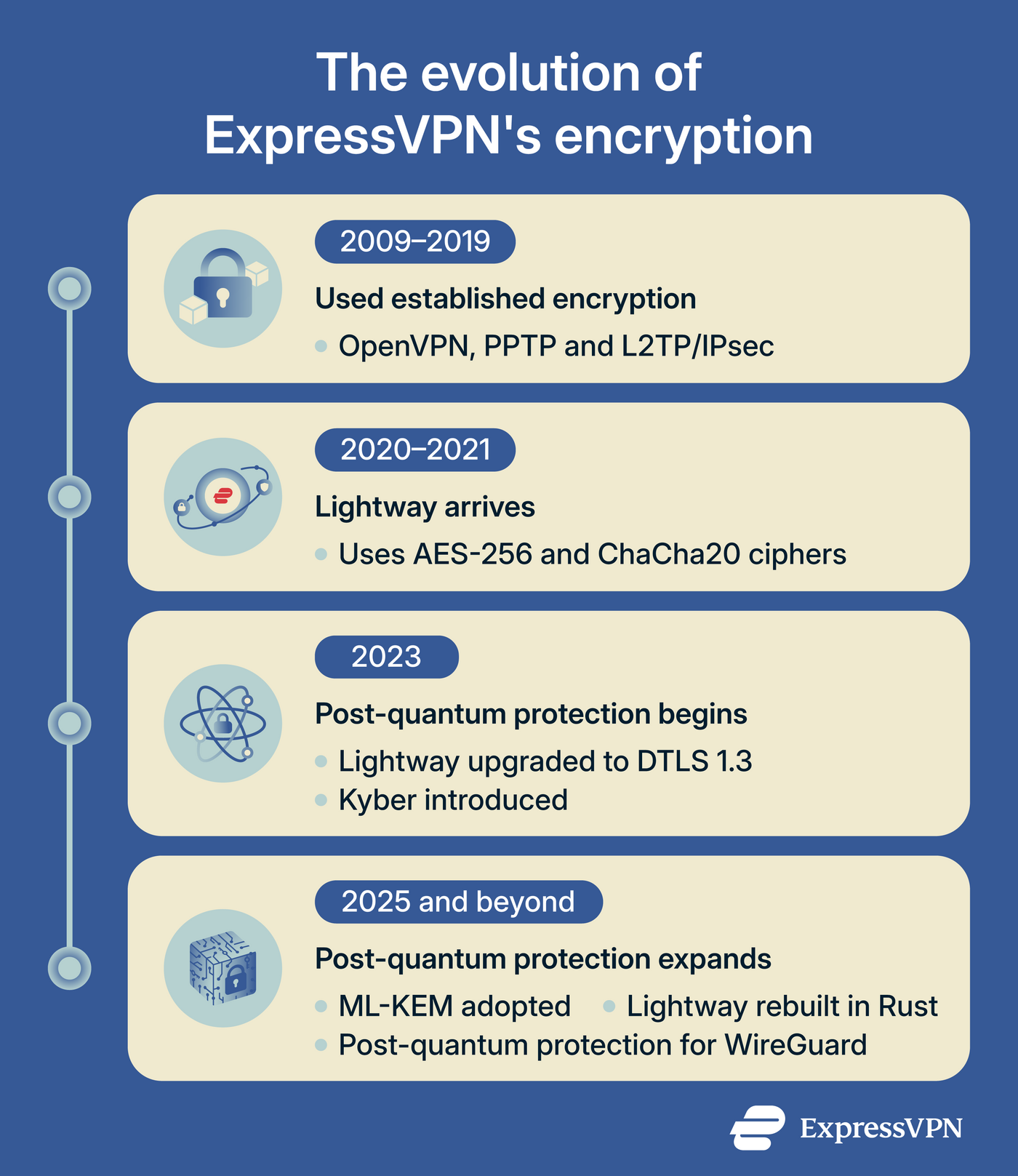
ExpressVPN’s encryption and VPN protocols have come a long way since its 2009 launch. One of the biggest developments was introducing Lightway, ExpressVPN’s own VPN protocol designed for speed, security, and reliability.
More recently, ExpressVPN added post-quantum protection to Lightway’s key exchange process, which safeguards it against possible decryption by quantum computers in the future.
2009–2019: ExpressVPN's original VPN protocols
Before developing Lightway, ExpressVPN relied on established VPN protocols, such as OpenVPN, which it still offers today. OpenVPN supports strong encryption, including Advanced Encryption Standard (AES)-256, to help prevent third parties from reading intercepted VPN traffic.
ExpressVPN also previously supported older protocols, including Point-to-Point Tunneling Protocol (PPTP) and Layer 2 Tunneling Protocol over Internet Protocol Security (L2TP/IPsec), but has since discontinued both. PPTP is no longer considered secure, while L2TP/IPsec has limitations compared with newer protocols.
2020–2021: ExpressVPN develops Lightway
In 2020, ExpressVPN began beta-testing Lightway, its own VPN protocol. Built on established encryption technologies, Lightway was designed to establish secure connections faster and stay stable when users switched between Wi-Fi and mobile networks.
Lightway fully launched in 2021, offering faster connection times and fewer interruptions while maintaining strong encryption.
Building Lightway around established cryptography
Although ExpressVPN developed Lightway from the ground up, it didn't create new encryption algorithms. Instead, it relies on wolfSSL, an established cryptographic library, to implement two existing encryption methods: AES-256-GCM and ChaCha20-Poly1305.
AES-256-GCM benefits from hardware acceleration on many modern devices, allowing it to encrypt internet traffic efficiently with minimal performance overhead. ChaCha20-Poly1305, on the other hand, performs well on devices without dedicated AES acceleration.
Lightway also uses forward secrecy, which helps prevent attackers from using stolen information to decrypt past VPN traffic.
Making Lightway open source and independently audited
In 2021, ExpressVPN made Lightway's core code open source, allowing independent security researchers to examine how the protocol implements encryption and manages secure connections.
ExpressVPN also commissioned an independent security assessment from Cure53 in 2021, which examined Lightway's implementation to identify potential vulnerabilities and areas for improvement.
Publishing the code and commissioning external audits made Lightway's security design more transparent and open to scrutiny.

Note: Audits don’t guarantee software is free of vulnerabilities, but they provide another way to evaluate whether its encryption and other security protections are implemented correctly.
2023: Strengthening Lightway and introducing post-quantum protection
In 2023, ExpressVPN made two major improvements to Lightway: upgrading how it establishes and maintains secure connections and introducing post-quantum protection.
Upgrading Lightway to DTLS 1.3
ExpressVPN upgraded Lightway from Datagram Transport Layer Security (DTLS) 1.2 to DTLS 1.3. DTLS helps Lightway establish encrypted connections, authenticate servers, and protect data against tampering.
The upgrade to DTLS 1.3 simplified the handshake process, which involves exchanging information to establish a secure connection. This reduced the data exchanged during connection setup and removed support for outdated cryptographic methods.
DTLS 1.3 also improved rekeying (generating fresh encryption keys during an active connection). Although Lightway already supported rekeying, the upgrade made it simpler and more efficient, allowing keys to refresh with less disruption to the VPN connection.
Adding post-quantum protection with Kyber
In October 2023, ExpressVPN introduced post-quantum protection into Lightway using Kyber, a cryptographic algorithm designed to help secure key exchanges against potential quantum-computer attacks.
One potential threat is known as "harvest now, decrypt later." An attacker could intercept and store encrypted internet traffic, hoping future quantum computers will be powerful enough to break the cryptography used to establish encryption keys and decrypt the recorded traffic.
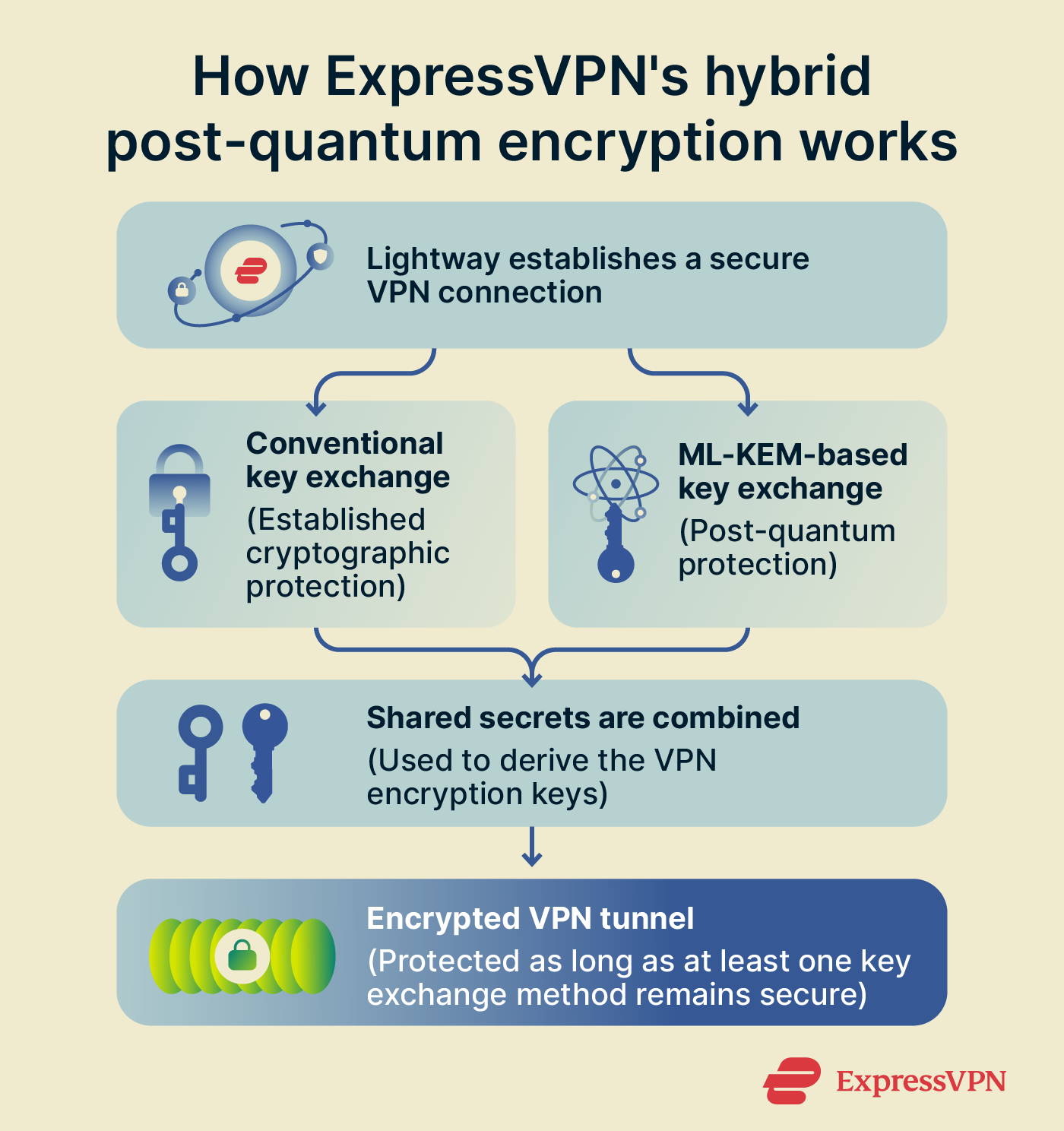
To reduce this risk, ExpressVPN adopted a hybrid approach, combining conventional key exchange with Kyber-based post-quantum cryptography. Both methods help establish the encryption keys protecting the VPN connection, so compromising one method isn't enough to reveal those keys.
2025: Upgrading to ML-KEM and expanding post-quantum protection
In 2025, ExpressVPN built on the post-quantum protection it introduced in 2023 by adopting a standardized cryptographic algorithm, strengthening Lightway’s implementation, and extending post-quantum protection to WireGuard.
Moving from Kyber to ML-KEM
ExpressVPN upgraded Lightway's post-quantum key exchange from Kyber to the Module-Lattice-Based Key-Encapsulation Mechanism (ML-KEM), a standard published by the U.S. National Institute of Standards and Technology (NIST).
ML-KEM builds on Kyber and incorporates changes made during the standardization process. By adopting ML-KEM, ExpressVPN aligned Lightway with a publicly documented standard that security researchers can evaluate and developers can implement consistently.
Rebuilding Lightway in Rust
ExpressVPN also rebuilt Lightway in Rust, replacing its original C code. Rust helps prevent common memory-safety errors, such as accessing memory after it has been freed. These errors can create vulnerabilities that attackers could exploit to access sensitive information or disrupt VPN connections.
The move also made Lightway's code easier to maintain and expand. ExpressVPN commissioned independent security assessments of the Rust implementation to help identify and fix potential weaknesses.
Introducing post-quantum WireGuard
In 2025, ExpressVPN also introduced its own post-quantum WireGuard implementation.
Like Lightway, ExpressVPN's WireGuard implementation uses a hybrid approach that combines conventional cryptography with ML-KEM. This adds protection against potential future quantum attacks while retaining the security benefits of established cryptographic methods.
The WireGuard implementation also uses short-lived session credentials, limiting how long each credential remains valid. Together, these measures help protect the establishment of encrypted VPN connections and reduce the risks associated with compromised credentials.
How ExpressVPN protects VPN connections today
ExpressVPN uses established encryption algorithms and secure key exchange to protect internet traffic traveling between your device and its VPN servers. Both Lightway and ExpressVPN's WireGuard implementation also support hybrid post-quantum key exchange, helping protect against potential attacks from future quantum computers.
You don't need to select a VPN protocol manually. ExpressVPN's automatic setting, which is enabled by default, chooses a suitable protocol for your connection. Lightway is usually selected, but you can also choose other available protocols through the app's settings.
Want to keep your internet traffic encrypted?
ExpressVPN uses strong encryption and post-quantum protection on supported connections to help keep your data private and protect against current and emerging security threats.
Protect your connection with ExpressVPN
Try it risk-free with a 30-day money-back guarantee for new users.
FAQ
Does ExpressVPN still support OpenVPN?
Is ExpressVPN's post-quantum protection enabled automatically?
What's the difference between Lightway and Lightway 2.0?
Can I choose between AES-256 and ChaCha20 in Lightway?
For most users, we recommend automatic selection. If your app supports manual cipher selection, see our Lightway encryption settings guide for the available options.
Do I need to update ExpressVPN to get the latest encryption improvements?
However, updating doesn't guarantee that every encryption feature will be active. Features such as post-quantum protection depend on your device, app version, and the VPN protocol you selected. For the latest available protections, use a supported, up-to-date app and keep the recommended automatic protocol setting enabled.