What is AES encryption, and how does ExpressVPN use it?


Advanced Encryption Standard (AES) is a widely used encryption method that scrambles data, making it unreadable without the encryption key. ExpressVPN uses AES-256-GCM to encrypt traffic between your device and the VPN server. The 256 refers to the key length in bits, while Galois/Counter Mode (GCM) lets the receiving device verify the data is authentic and hasn't been altered in transit.
How does AES encryption work in ExpressVPN?
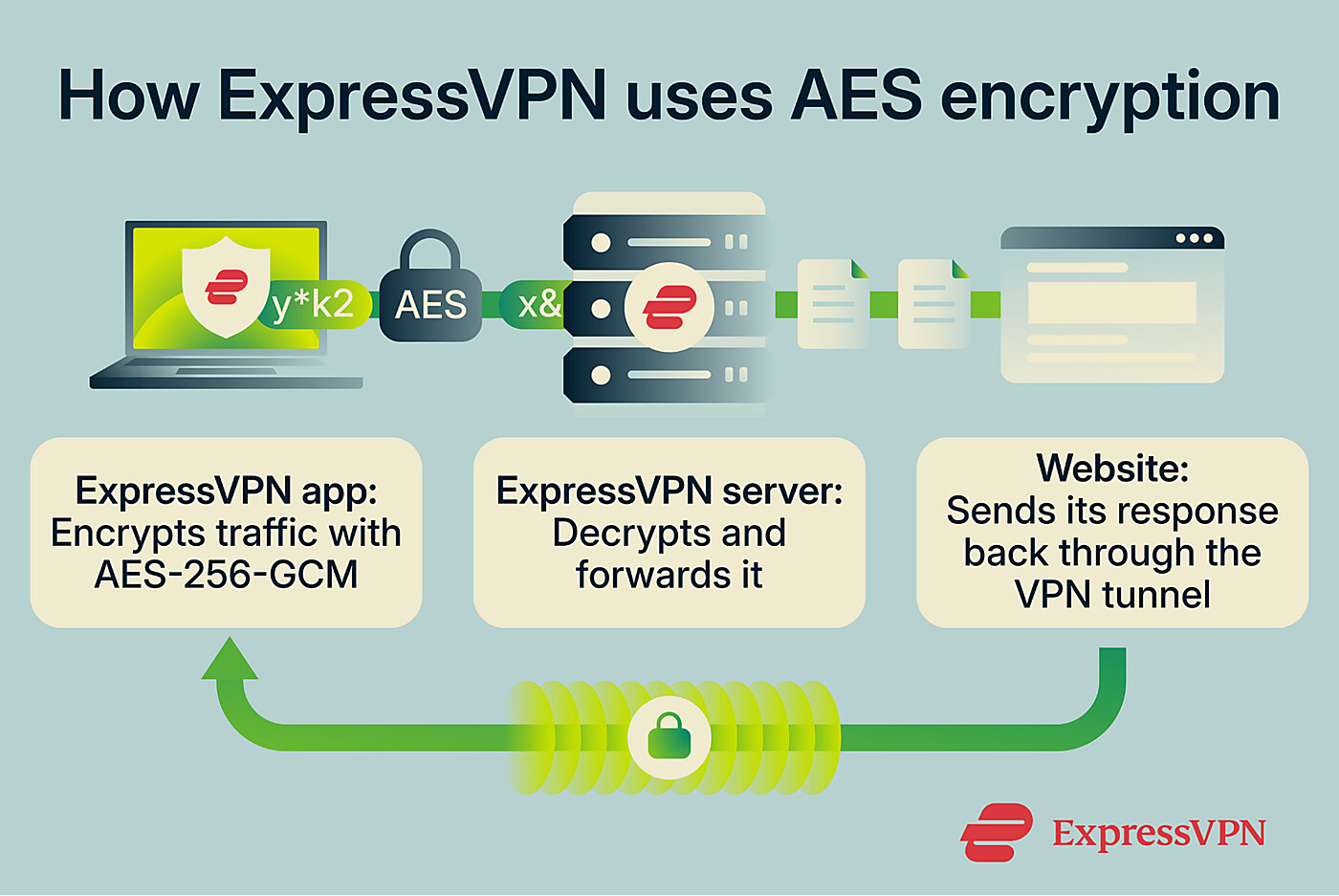
ExpressVPN supports both AES-256-GCM and ChaCha20/Poly1305 encryption. When your ExpressVPN connection uses AES-256-GCM, the app encrypts outgoing traffic on your device before sending it through the VPN tunnel. This prevents your internet provider and other parties from reading the traffic and allows the system to detect tampering.
When the traffic reaches the ExpressVPN server, it removes the VPN encryption layer before forwarding it to its destination.
Replies from the destination follow the same process in reverse: the server encrypts them for the return journey, and the app decrypts them on your device.
This means ExpressVPN's encryption protects traffic between your device and the VPN server. If you're visiting an HTTPS website, HTTPS provides a separate layer of encryption between your browser and the website, even after the VPN encryption is removed.
Where does ExpressVPN use AES?
ExpressVPN uses AES to protect both VPN traffic and sensitive information stored in ExpressKeys, its password manager.
AES-256-GCM in Lightway
Lightway, ExpressVPN's VPN protocol, can use AES-256-GCM to encrypt traffic between your device and an ExpressVPN server. This prevents your internet provider and others from reading the traffic inside the VPN tunnel.
AES in ExpressKeys
ExpressKeys uses AES-256 to encrypt passwords and other sensitive information stored in your vault. Your vault password stays on your device, where you decrypt your data when you unlock the vault. This means ExpressVPN can't read your stored information.
Is AES-256 still secure?
Yes. AES-256 is a secure encryption standard when implemented correctly. Its 256-bit key allows so many possible combinations that trying them all would be impractical with today's computing power. Researchers have used AI to investigate weaknesses in encryption systems, but no published research has demonstrated that AI can break properly implemented AES-256.
However, strong encryption doesn't guarantee a secure VPN. The software that uses that encryption, and the additional security measures around it, are just as important. For example, AES-256-GCM is just one part of ExpressVPN's Lightway protocol. Lightway's core code is open source and has undergone independent security audits to identify and address potential vulnerabilities that could affect VPN security.
Similarly, ExpressKeys relies on a strong, unique vault password to protect its encryption key and has also undergone independent security audits to help protect your stored data.
Keep your internet traffic encrypted
ExpressVPN uses strong encryption to protect traffic between your device and the VPN server, helping prevent your internet provider and others on the network from reading your data.
Protect your connection with ExpressVPN
Try it risk-free with a 30-day money-back guarantee for new users.