How ExpressVPN protects your data against future quantum threats



Quantum computers could eventually pose a threat to some of the encryption used to protect our internet traffic today. This creates a risk now, as data intercepted today can be stored until sufficiently powerful quantum computers exist that are capable of decrypting it.
To address this long-term risk, ExpressVPN has introduced post-quantum cryptography in the Lightway and WireGuard protocols. This protection works on conventional hardware and is designed to resist attacks from future quantum computers.
Why ExpressVPN uses post-quantum cryptography
ExpressVPN uses post-quantum cryptography because the classical cryptography VPNs use to establish secure connections could potentially be broken at some point by a sufficiently powerful quantum computer, putting user data at risk.
This vulnerability exists because quantum computers work in a completely different way than classical computers, which breaks the assumptions on which classical cryptography is built. The classical cryptography VPNs use is based on mathematical problems that classical computers can technically solve, but only with an unrealistic amount of time.
For example, a classical computer might take a billion years to break a conventional encryption key like a 2048-bit Rivest–Shamir–Adleman (RSA) key. A sufficiently powerful quantum computer, on the other hand, might do it in just a couple of minutes.
Such a computer doesn’t exist yet. But it’s important to prepare for the possibility, because attackers can gather encrypted traffic now with the intent of decrypting it later once the technology becomes available. This tactic is sometimes referred to as "harvest now, decrypt later." It's a big deal because some data stays sensitive for decades (think financial records or personal credentials).
How ExpressVPN's post-quantum protection works
A VPN connection uses cryptography in two different areas. First, it’s used during key establishment, where the VPN client and server securely agree on the keys they’ll use to encrypt and decrypt data sent through the VPN connection. Second, it’s used to encrypt the data sent through the connection.
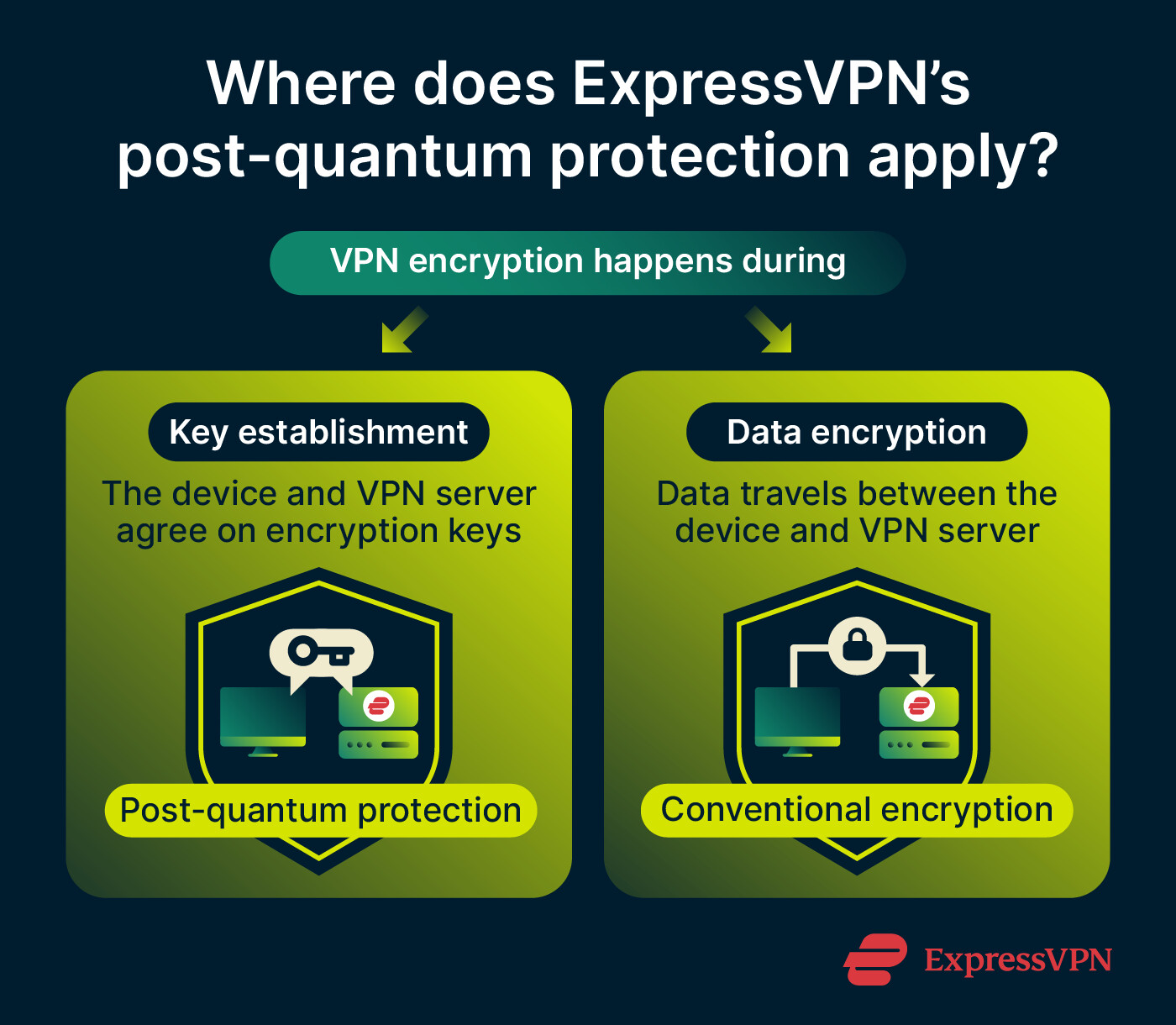
ExpressVPN’s post-quantum protection focuses on the key establishment process, rather than replacing every component of VPN encryption. VPN traffic is still encrypted using conventional symmetric encryption algorithms, such as Advanced Encryption Standard (AES)-256-GCM or ChaCha20-Poly1305, depending on the protocol and configuration.
ExpressVPN offers post-quantum protection for VPN connections in both its Lightway and WireGuard implementations.
Post-quantum protection in Lightway
ExpressVPN uses the Module-Lattice-Based Key-Encapsulation Mechanism (ML-KEM) cryptographic algorithm to add post-quantum protection to its proprietary Lightway protocol. During key establishment, ML-KEM helps the VPN client and server establish a shared secret that can then be used to protect the VPN session.
ML-KEM was selected by the National Institute of Standards and Technology (NIST) as a standard for post-quantum encryption. It was chosen after years of evaluation and analysis by leading cryptographers from around the world and offers strong post-quantum security with high performance.
Post-quantum protection in WireGuard
ExpressVPN developed a post-quantum implementation for WireGuard that also uses ML-KEM to protect the key-establishment process. This adds post-quantum protection that isn't part of the standard WireGuard protocol.
Unlike with Lightway, this was accomplished without modifying WireGuard itself. Instead, the necessary post-quantum key exchange and other supporting components are added around the existing protocol, providing better protection while preserving the protocol’s inherently fast speeds.
Why ExpressVPN uses a hybrid approach
ExpressVPN uses both conventional and post-quantum cryptography for Lightway and WireGuard because this hybrid approach helps protect the key establishment process and the resulting VPN connections against attacks from both classical and quantum computers. It also helps maintain compatibility with existing cryptographic systems while post-quantum cryptography is introduced more widely.
How to use ExpressVPN's post-quantum protection
You automatically benefit from ExpressVPN’s post-quantum protection so long as you’re using the Lightway or WireGuard protocols on a supported platform and are using the latest version of the ExpressVPN app. You don’t need to change any settings or turn it on manually.
Supported platforms include Windows, macOS, Android, iOS, Linux, and Apple TV.
Note that by default, ExpressVPN’s apps use the Automatic protocol option, which automatically chooses the best protocol for your network conditions. This is usually (but not always) Lightway. If you want to ensure that your data is protected by ExpressVPN’s post-quantum protection at all times, you can manually select the Lightway or WireGuard protocols.
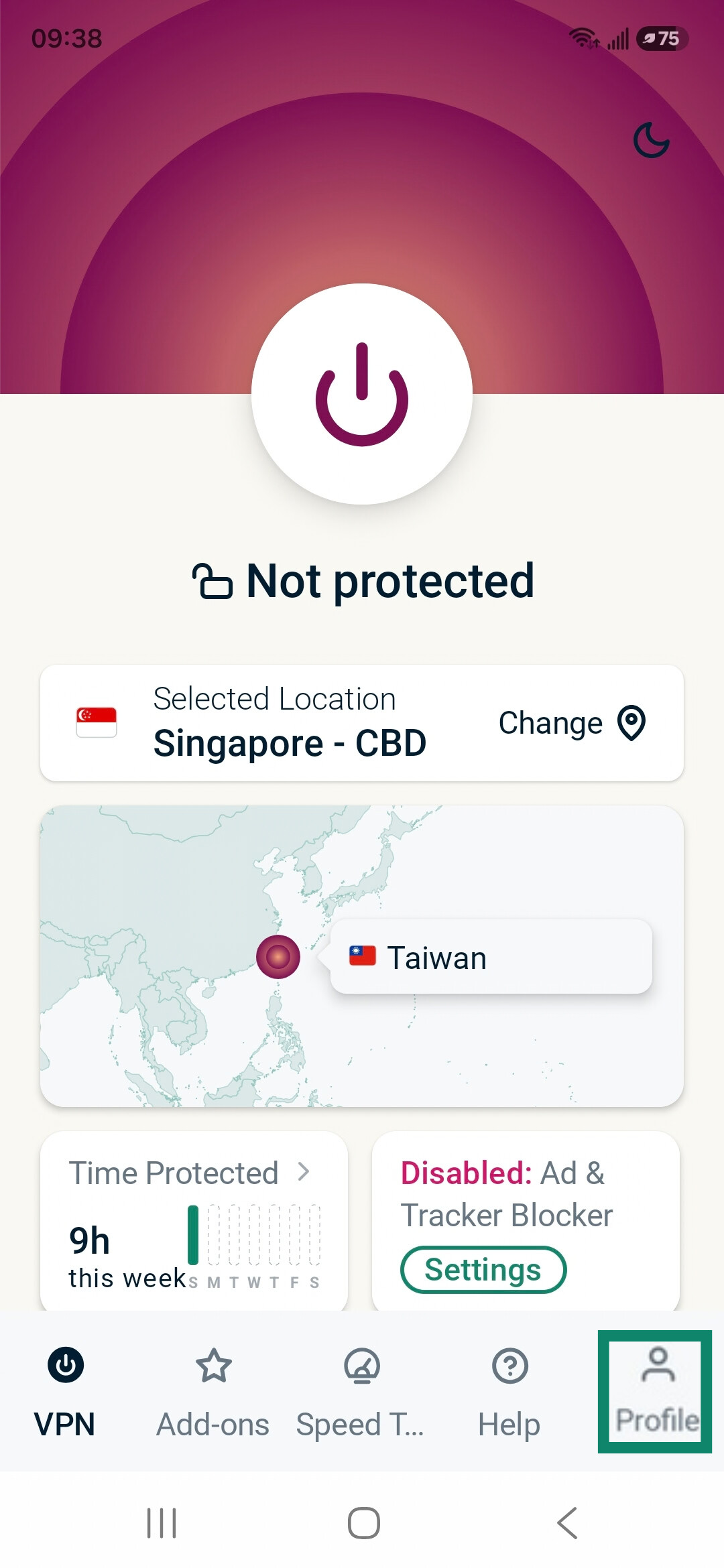
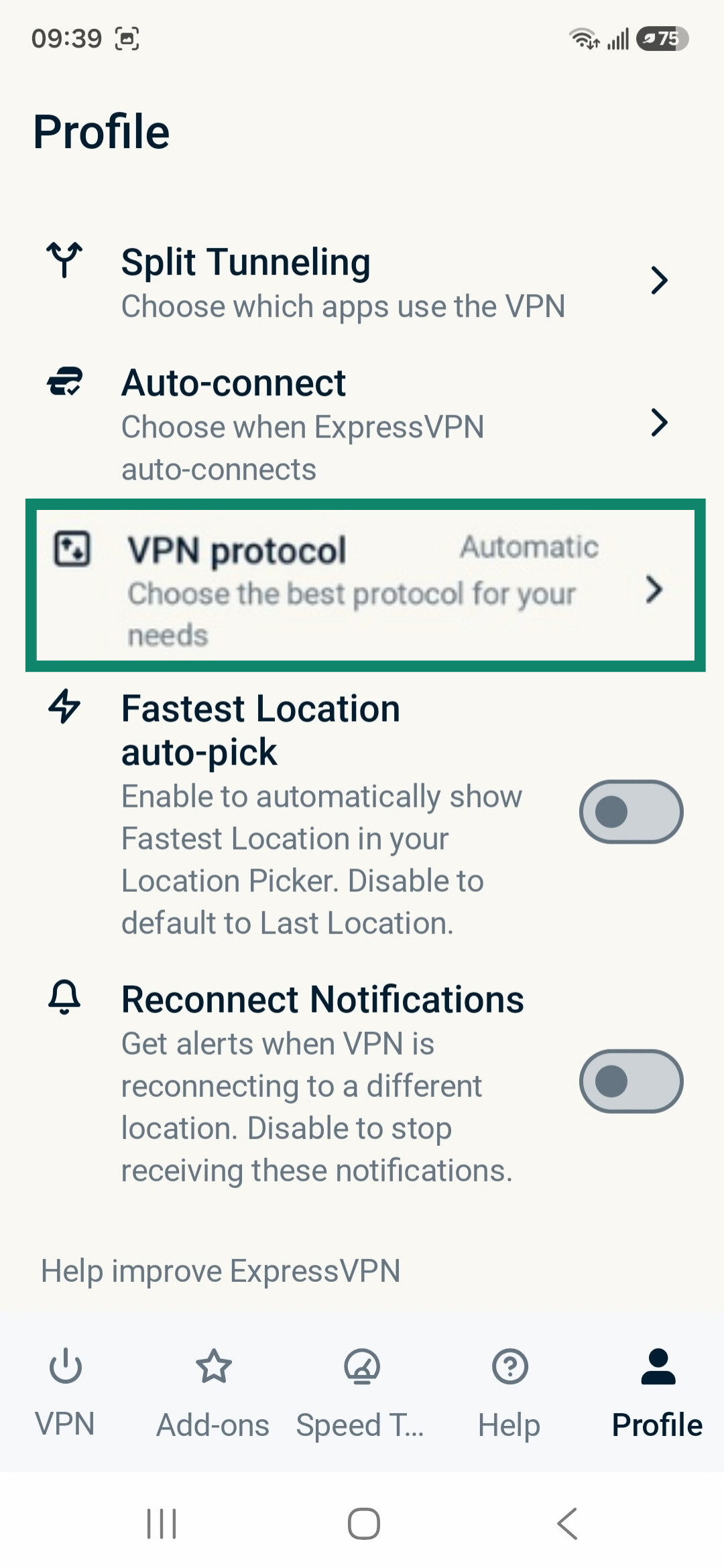
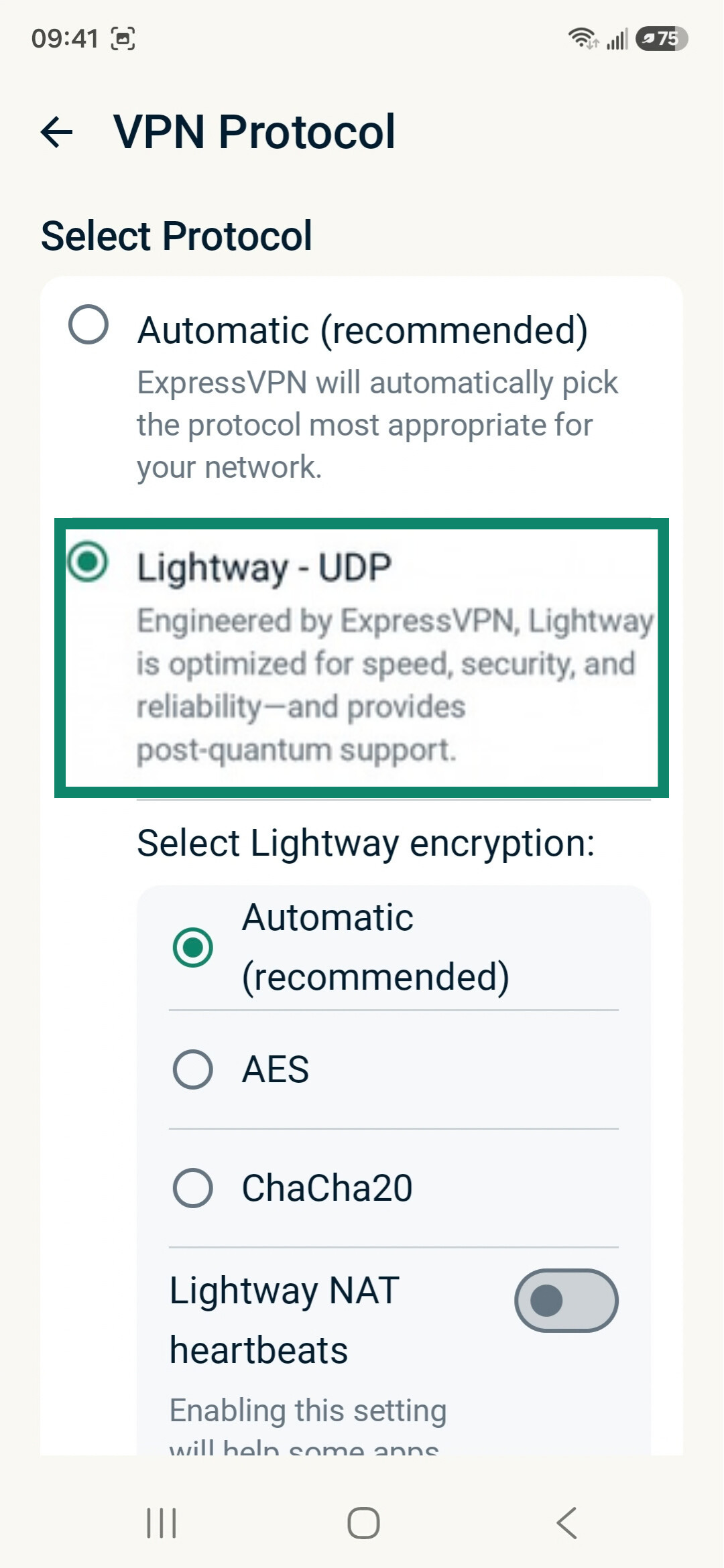
Here’s how to change the protocol, using the Android app as an example:
- In the ExpressVPN app, tap Profile.
- Tap VPN protocol.
- Select Lightway – UDP, Lightway – TCP, or WireGuard.
See the following guides for instructions on how to change the VPN protocol on other platforms:
What are the limitations of ExpressVPN's post-quantum protection?
ExpressVPN’s post-quantum protection doesn’t make every aspect of your internet connection quantum-resistant. As explained earlier, it only addresses the quantum threat to the cryptographic mechanisms used to establish a secure connection. It doesn’t apply to every component of the VPN connection.
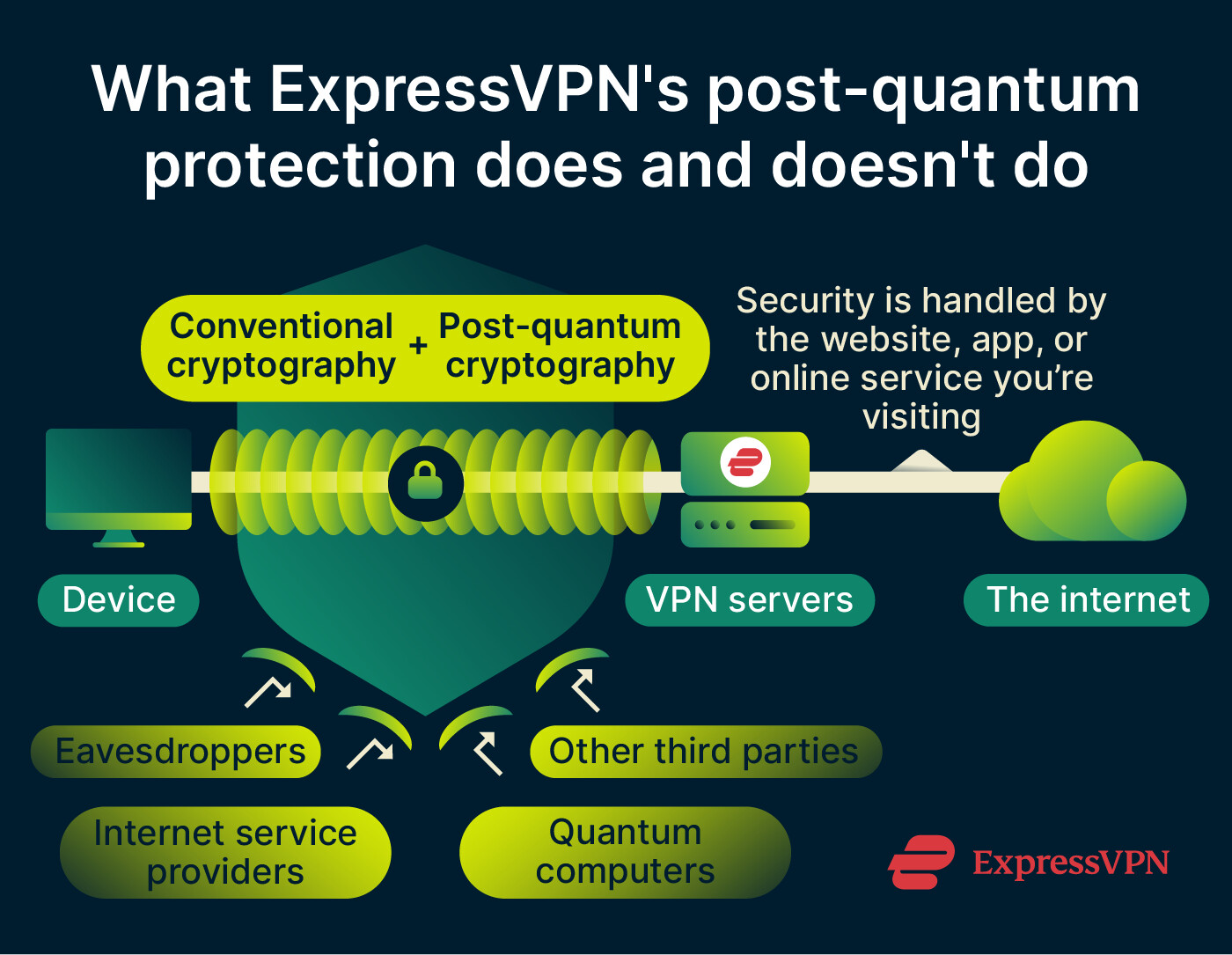
Additionally, while ExpressVPN’s post-quantum protection secures the connection between your device and the VPN server, it has no control over the connection from the VPN server to the website or other online service. That part of the connection is handled by the website, app, or other online service you're using, which may or may not provide post-quantum protection.
Build quantum resilience into your VPN connection
ExpressVPN helps protect your VPN connection against today’s threats and the potential quantum threats of the future, with post-quantum cryptography built into the Lightway and WireGuard protocols.
Get post-quantum protection with ExpressVPN
Try ExpressVPN with a 30-day money-back guarantee for new users.