Expressvpn Glossary
Network optimization

What is network optimization?
Network optimization is the process of improving how data moves across a network. The goal is to keep applications responsive and connections reliable.
Rather than relying on a single setting or device, network optimization involves measuring performance, adjusting configurations, and automating responses.
It's commonly used in internet service provider (ISP) infrastructure, enterprise networks, cloud platforms, and home Wi-Fi environments.
How does network optimization work?
Network optimization begins by establishing a baseline. Latency, throughput, jitter, packet loss, and other factors are measured using monitoring tools and connection tests. This is done so that any improvements can be properly measured.
The optimization process typically follows several steps:
- Identify bottlenecks: Congestion can result from overloaded links, inefficient routing paths, slow servers, or wireless interference.
- Apply traffic controls: Techniques such as Quality of Service (QoS) prioritization regulate how data is sent during peak periods, helping time-sensitive traffic, such as voice or video, get preferential treatment.
- Improve delivery paths: Routing adjustments and other methods can modify how requests are directed to servers and reduce the distance data must travel.
- Validate performance: Changes are continuously tested and adjusted as traffic patterns evolve.
In a home network, optimization may involve router placement, reducing wireless interference, or adjusting settings and coverage equipment such as extenders or mesh systems. In larger networks, optimization tools may automatically adjust routing and traffic handling as conditions change.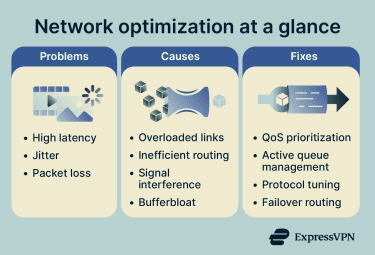
Why is network optimization important?
Modern services rely on stable connections. Even small delays can reduce responsiveness, especially for interactive and real-time services.
Under the right circumstances, network optimization can help:
- Improve responsiveness: Websites and applications load and react faster.
- Support real-time services: Video calls, streaming, and gaming remain more stable under load.
- Reduce waste: Bandwidth and infrastructure resources are used more efficiently.
- Handle spikes: Networks stay usable during peak traffic periods.
- Enable scaling: Systems can grow without major performance degradation.
Many connection problems occur even when the internet speed appears high. A network can have sufficient bandwidth but still feel slow if latency or packet loss is high. Optimization addresses timing and reliability rather than raw speed.
However, optimization cannot overcome fundamental limits. If a connection lacks sufficient bandwidth, the hardware is underpowered, or uncontrollable factors degrade the wireless signal, performance problems may persist even if a network is optimally configured.
Where is it used?
Network optimization is used anywhere stable connectivity is required.
ISPs and mobile operators apply it to manage congestion and traffic between networks. Enterprises use optimization to support remote access, branch connectivity, and software-defined wide area network (SD-WAN) capabilities, enabling users to more reliably reach internal applications, cloud services, and internet resources.
Cloud platforms rely on optimization to keep applications responsive across data centers and microservices. Streaming, Voice over Internet Protocol (VoIP), and video conferencing services depend on it to maintain more consistent audio and video quality.
It also plays a key role in optimizing wireless networks, particularly Wi-Fi, where interference and signal quality affect performance. In connected logistics and Internet of Things (IoT) systems, network optimization helps sensors and tracking devices report data more reliably and with lower delay.
Risks and privacy concerns
To optimize a network, it’s usually necessary to first observe traffic behavior. In many cases, this involves analyzing metadata such as timing, volume, and destination rather than the full content of communications. Still, this visibility can introduce privacy and security considerations.
Possible concerns include:
- Usage monitoring: Collected telemetry may reveal browsing patterns.
- Traffic discrimination: Prioritization policies may disadvantage some traffic classes or, in some cases, be used to throttle certain traffic.
- Deep packet inspection (DPI): Inspecting packet contents can expose communication contents to monitoring systems, which may reduce confidentiality.
- Configuration errors: Misconfigured QoS may disrupt applications.
- Expanded exposure: Optimization platforms may increase the attack surface.
If privacy is an important factor, optimization should rely on limited telemetry, use encrypted traffic where possible, and restrict administrative access.
Further reading
- How to increase bandwidth when using a VPN
- How to fix packet loss for a stable connection
- What is bandwidth throttling and how do you stop it
- How to test your internet speed
- How to boost Wi-Fi signal at home to get faster internet