Expressvpn Glossary
EtherNet/IP

What is EtherNet/IP?
Ethernet Industrial Protocol (EtherNet/IP) enables automation systems to transport control and device data, such as sensor readings, motor commands, and diagnostics, over Ethernet networks.
It belongs to the Common Industrial Protocol (CIP) family. CIP defines the application-layer services and objects that industrial devices use to exchange data and perform functions like configuration and diagnostics, while EtherNet/IP carries that communication over Ethernet.
Because it runs on standard Ethernet (IEEE 802.3) with the Transmission Control Protocol (TCP) / Internet Protocol (IP) suite, it can use widely available Ethernet infrastructure, although devices must support EtherNet/IP, and industrial deployments may require appropriately selected network equipment.
EtherNet/IP also supports different communication models on the same network, including controller-to-device and device-to-device data sharing.
How does EtherNet/IP work?
EtherNet/IP works by encapsulating CIP messages inside standard Ethernet frames and transporting them using TCP/IP and User Datagram Protocol (UDP) / Internet Protocol (UDP/IP).
EtherNet/IP also supports two primary communication types:
- Explicit messaging (TCP-based): Used for configuration, diagnostics, and other non-time-critical exchanges. These messages follow a request-and-response model.
- Implicit messaging (UDP-based): Used for time-sensitive input/output (I/O) data sent in repeating cycles for control applications.
EtherNet/IP also uses a producer–consumer model, in which a device publishes data that multiple devices can receive simultaneously. This reduces duplicate traffic compared to point-to-point exchanges.
Beyond its core messaging, EtherNet/IP supports several CIP-based extensions. CIP Safety enables safety communication over standard networks for functional safety applications, and CIP Motion adds synchronized motion control across devices.
Lastly, device profiles provide standardized device definitions, data formats, and behaviors that improve interoperability between products from different vendors.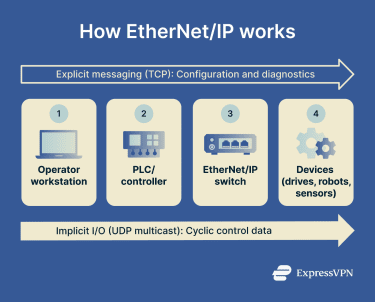
Why is EtherNet/IP important?
Industrial environments adopt EtherNet/IP because it offers several practical advantages over proprietary industrial networks:
- Connects industrial devices over Ethernet: EtherNet/IP uses IEEE 802.3 Ethernet with the TCP/IP suite, allowing industrial devices to communicate over widely used Ethernet infrastructure rather than only proprietary networks.
- Combines control and standard traffic: It can carry time-sensitive I/O and control traffic alongside configuration, diagnostics, and other information exchanges on the same network.
- Improves multi-vendor interoperability: Standardized CIP device profiles define common objects, configuration options, and I/O data formats, helping products from different manufacturers work together when they implement the same profiles.
- Bridges plant-floor and enterprise networks: EtherNet/IP is designed to support integration between industrial control systems and enterprise networks, which can improve visibility and data sharing beyond isolated control environments.
Where is it used?
EtherNet/IP is common in industrial automation environments where controllers, drives, sensors, and supervisory systems need to exchange data over Ethernet, such as:
- Manufacturing and assembly: Connects programmable logic controllers (PLCs), distributed I/O, and inspection systems in discrete manufacturing environments.
- Robotics and motion control: Supports coordinated communication between motion systems, servo drives, and robotic equipment.
- Packaging and material handling: Supports conveyor systems, sortation equipment, and automated packaging lines that require synchronized communication.
- Process industries: Connects controllers to field instrumentation in continuous process environments such as chemicals, oil and gas, and food processing.
- Utilities and supervisory control environments: Can integrate operational technology (OT) equipment with supervisory systems and broader enterprise networks in some industrial and infrastructure deployments.
Risks and privacy concerns
EtherNet/IP deployments can introduce security risks without proper network configuration, access controls, and monitoring. These include:
- Lateral movement: Without segmentation, attackers who compromise one device may be able to move across controllers and field devices in the same network zone.
- Data exposure: Traditional EtherNet/IP traffic is often not encrypted or authenticated by default, so control commands and operational telemetry may be visible to anyone with network access unless protections such as CIP Security are implemented.
- Device fingerprinting: Standardized CIP device objects and profiles can make it easier for scanning or management tools to identify device types when access controls are weak.
- Multicast abuse: The producer-consumer model relies on multicast traffic, which may increase network load or be exploited if not properly managed.
- Expanded attack surface: Integrating industrial systems with enterprise or remote access networks can create additional entry points that require additional security.
Further reading
- What is IIoT, and why its security matters more than ever
- IoT cybersecurity: What it is and why it's critical for modern networks
- IoT vulnerabilities: How to identify and secure connected devices
- Ultimate guide to IoT device security
- IIoT vs. IoT: What's the difference and why it matters