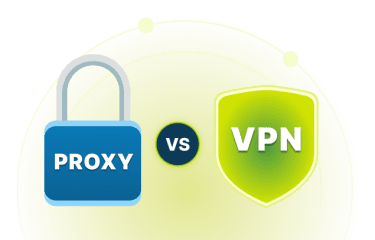
Proxy vs. VPN
If you’re looking to change your IP address online, you’ve probably come across terms like “proxy server,” “VPN proxy,” “proxy server network,” or “free web proxy.” But is there a difference between a proxy and a VPN? Read on to find out.

What is a proxy server?
A proxy server is an intermediary between your device and the internet.
-
A proxy server can sit on your local router, where it increases network efficiency, authenticates users on your network, and enforces content restrictions. These proxies are typically found at Wi-Fi hotspots in hotels or airports. They require no configuration by you, as a user.
-
A proxy can also be on a remote server, where it will not be subject to the restrictions that might be imposed by a proxy on your local network. Such a proxy will need to be configured by you and can help to change your true IP address and encrypt your traffic.

Why are there free proxy servers?
As with free VPNs, the operators of a free proxy web server need to recover their costs. They can do this by injecting ads into your traffic or by selling your data to advertisers. Either way, there is very little incentive for online proxy sites to keep your browsing fast, secure, and anonymous.
Remember, both paid and free proxy servers should always encrypt their traffic with HTTPS to make sure it is not monitored or altered in transit.
Should I use a free proxy?
Before connecting to a free proxy server, do some research into whether it encrypts its traffic or merely claims to. You may end up sacrificing more than you bargained for in both speed and security.

Advantages of a VPN vs. a free proxy
Once you have the ExpressVPN app installed, selecting a location becomes easy and fast, and all your traffic is protected with strong encryption. This keeps your internet connection secure, while helping to bypass threats on your local network.
Not all proxy servers are malicious by nature, but it can be extremely difficult to separate the bad from the merely harmless. One test of over 20,000 proxy services found nearly all of them to inject some form of malware.
Speed is another important consideration. Free proxy servers are usually choked with an avalanche of users trying to get a free ride on what ends up becoming a very slow, congested highway. A premium VPN is like a private tunnel for you and your data, constantly optimized for stability and speed.
What’s the main difference between a proxy and a VPN?
Technically speaking, a VPN server is a proxy server—the terms “VPN” and “VPN proxy” are interchangeable—although it more commonly refers to HTTPS servers. If the proxy server is using HTTPS (also referred to as TLS, previously SSL), then it is actually very similar to a VPN, although a web proxy would only encrypt web traffic, while a VPN routes and encrypts all kinds of traffic through its servers.
Learn more about using a VPN
-
![What is a VPN?]()
What is a VPN?
Get to know how a VPN protects your online traffic from snooping.
-
![Encrypt your data]()
Encrypt your data
Strong encryption protects your data and communication
-
![No activity logs]()
No activity logs
ExpressVPN does not see or record what websites you visit



-
 Discount of up to 73%
 -
 2 Years + 4 Months
 -
 FREE eSIM + up to 5 days unlimited data
 -
 30-day money back guarantee for first time users